
Editor’s Note: In the airport food and beverage world, chefs and culinary executives are constantly tracking emerging dining trends, evolving consumer preferences, and operational challenges, all with an eye toward elevating the traveler experience. For the July/August issue of Airport Experience News, AXN’s Sally Kral connected with culinary leaders from some of North America’s top airport food and beverage concessionaires to get their insights on the latest developments.
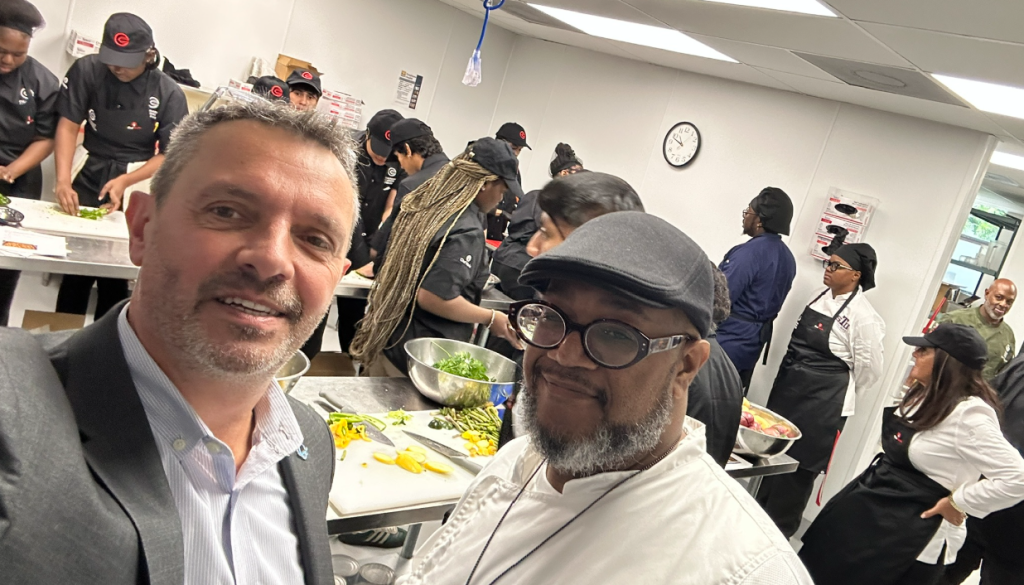
Alongside the feature story in the magazine, Kral asked each leader a series of additional questions. In the first installment of this web-exclusive Q&A series, Eric Baines, director of food and beverage, and Alain Zemmour, vice president of operations at Concessions International, share their personal stories, experiences and vision for the future of airport dining.
To read the full feature on the industry’s leading culinary directors, log in, subscribe, or check out the July/August print edition of Airport Experience News
Kral: What’s your hospitality background and how did you get into the airport industry?
Chef Eric Baines: I started in this industry as a line cook at a British pub in San José airport in 2009 I believe. It was my second career—I was a graphic designer for 10 years, and I quickly realized that it was eating me alive that I wasn’t cooking, that I wasn’t doing something with food. So I got a job at an airport restaurant and had no idea what I was getting myself into with all the idiosyncrasies of an airport operation, but I learned a lot and within maybe 18 months I was running the kitchen and probably six to eight months after that, I was running all the kitchens at San José. And then the general manager of that airport was moving to another airport [with] a bigger program, and he asked me if I wanted to come along and be the culinary manager. I moved my entire family from the Bay Area to Chicago and he and I oversaw the build out and the restaurants in Terminal 5 at Chicago O’Hare. We worked with some really great brands. I did a lot in San José but I learned so much in Chicago and ended up transitioning out of the kitchen and became assistant general manager of the airport.
Then it started killing me again that I wasn’t dealing with food, so I took a position with SSP America in Seattle as a kitchen manager. Then COVID hit and they laid off pretty much every chef in the company. I ended up working as a sous chef at a boarding school but maybe six weeks in I got the call to come and work with CI. I started as a food and beverage manager, and I’ve since been promoted to director of food and beverage.
Alain Zemmour: I was born in France, and my family owned five restaurants growing up, and always said I would never, ever be in this industry—and here we are.
I always had a passion for food, and during my summer vacations and winter breaks growing up I would hang out in the kitchens. That’s something I still enjoy even though I’m not directly in kitchens anymore. Eric and I share that love for being back there, seeing things happen and how everything is made. I spent several years in the army, during which time I traveled a lot and not always under the best circumstances, but I caught the travel bug. I wanted to see the rest of the world, so I joined a hotel group with resorts around the world, but not in the kitchens, in the sports area, and that’s where I spent many years. I eventually moved to the United States. I was done with the resort life so I went back to restaurants and started waiting tables in Atlanta, and my English got much, much better. I would go on to open my own restaurant, a little French bistro, in the Atlanta suburbs but people stopped eating French food during the Iraq war and I lost everything.
So, how do we rebuild? We go back to where we can make money. I can serve, I can bartend, I can cook. I started bartending at the Ritz-Carlton in Atlanta and that’s how I got back into running hotel operations, but this time on the food and beverage side.
I was working at the InterContinental and I fixed a situation on the floor during a Mother’s Day brunch and unbeknownst to me, this was noticed by Regynald Washington [then of Hojeij Branded Foods]. He made me an offer I could not refuse, bringing me into the Atlanta airport as director of operations. What really sold me was the pace. I had no idea that the airport pace was going to click like that with me, but that’s my personality, that’s who I am.
I would later get back into hotel food and beverage operations but I got bored very fast, because once you get a taste of the airport world, you can’t go back. Somebody reached out to me about a position with CI as a director of operations for Atlanta. I ended up getting the job, and nine years later I’m running all operations for the company, and I would not change a thing.
Kral: What are some of the biggest food and beverage trends in airports right now?
Baines: Airports are broadening their horizons and bringing in food from different cultures—Korean fried chicken, for example. Also, seafood-forward dishes. Ten years ago, a lot of people shied away from seafood or it wasn’t necessarily their first choice, especially in landlocked airports, but I think that the supply chain has evolved and gotten better product to those landlocked states and increased their food offerings as well.
Zemmour: Healthy concepts too. Ten years ago, you were weird if you were looking for an organic green juice, now it’s normal. You have to have something healthy. I think we’re going to start seeing more and more organic. It has started, but it’s not overwhelming yet. But I was in Denver recently and saw vending machines full of organic stuff—it’s going to get there.
Baines: Healthy wraps, kale wraps are going to be huge, and I think people are really embracing kale. I do Caesar salads on our menus with just kale. A lot of people didn’t understand how to make kale taste good, but I think that’s changing. And I just got back from the National Restaurant Association show in Chicago—two years ago, there were zero acai booths, last year there were two, this year there were six, and they were really busy.
Kral: What’s your approach to menu evolution to keep up with trends?
Baines: Specifically within CI and with our new CEO [Nikki Harland], there’s a reinvestment of time and attention to not a specific product or genre of food but in making what we’re doing the best that it possibly can be and trying to elevate the entire experience. I have this thing that I say to my cooks when they put a plate out that’s not looking right—I’ll say, “You didn’t love this plate. Take it back and re-plate it with some love on it.” That’s what I’m trying to push.
With my menus right now, including RFP menus, I’m doing recognizable ingredients but elevated. So instead of just doing a pork chop and throw it on the grill, we’re going to brine that pork chop so it has the flavor and the moisture that you want.
And when I’m out somewhere and I see something that knocks my socks off, I immediately send Alain a picture, and he does the same thing with me. And it doesn’t have to be just food. It could be service-oriented, it could be the way the order was taken. We’re constantly trying to evolve and raise the bar for what we’re doing in our locations.