
Editor’s Note: In the airport food and beverage world, chefs and culinary executives are constantly tracking emerging dining trends, evolving consumer preferences, and operational challenges, all with an eye toward elevating the traveler experience. For the July/August issue of Airport Experience News, AXN’s Sally Kral connected with culinary leaders from some of North America’s top airport food and beverage concessionaires to get their insights on the latest developments.
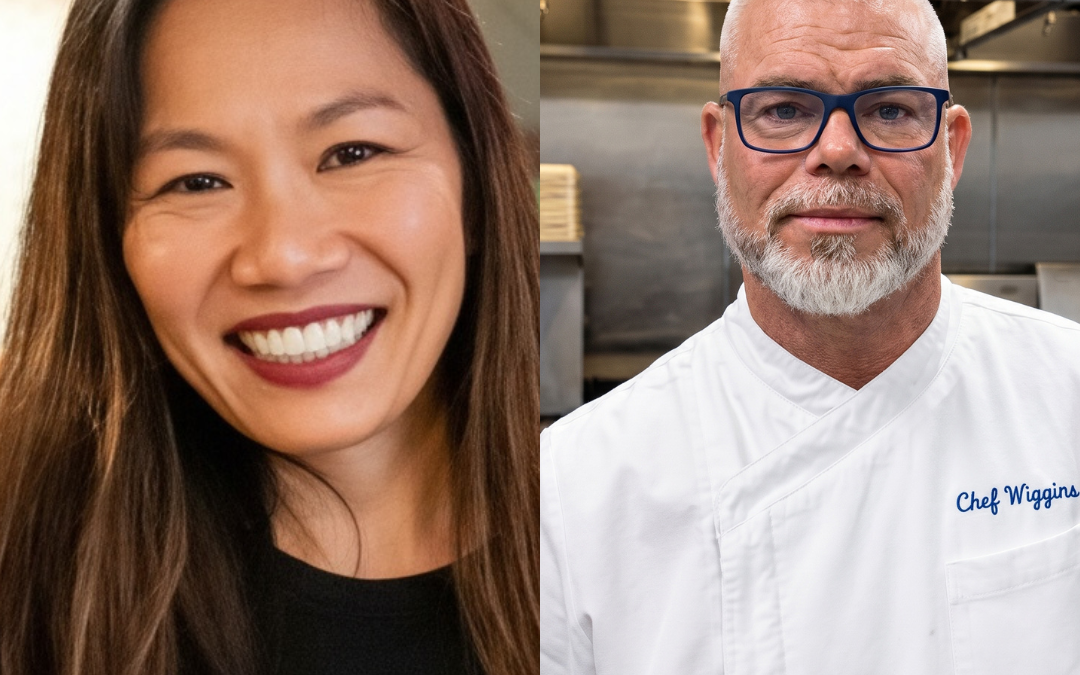
Alongside the feature story in the magazine, Kral asked each leader a series of additional questions. In the third installment of this web-exclusive Q&A series, Kral spoke with Alice Cheung, senior director of brands and concepts for the Dining Division and Chef Richard Wiggins, senior director of culinary for Paradies Lagardère.
To read the full feature on the industry’s leading culinary directors, log in, subscribe, or check out the July/August print edition of Airport Experience News.
Kral: What’s your hospitality background and how did you get into the airport industry?
Cheung: I always tell people I was born into the restaurant industry – my mom was pregnant with me when my parents opened their first restaurant. She likes to say I was the perfect restaurant kid: When it was busy and noisy, I’d nap in a stroller in the back, and when it quieted down, that’s when I’d wake up and need attention.
Throughout my childhood, I worked in my parents’ restaurants, and in college I waited tables and bartended. The day I graduated, I told my mom I’d never step foot in a restaurant again. Famous last words!
After a few years in radio and live music, I realized the restaurant industry is in my blood. I combined my marketing and communications degree with my passion for hospitality at Whole Foods and Aramark’s Higher Education division – this is where I first learned about RFPs.
About 14 years ago, I was introduced to what was then The Paradies Shops. Once I learned about the airport ecosystem, there was no turning back. There’s a new challenge every day, and I love it.
Wiggins: My hospitality career started young, working in private restaurants. At 19, I joined the Grand Hyatt Atlanta in Buckhead, which launched my hotel career. That path took me everywhere – Orlando, Miami, Atlanta, New Orleans, Washington, D.C., Arizona, Maui, Maine, New York, New Jersey and St. John in the U.S. Virgin Islands.
I first heard about Paradies Lagardère and airport dining through Leigh Allan [senior vice president of operations for the Dining Division]. We met over 16 years ago at the W Midtown Atlanta. Last year he told me he was leaving Hilton to become SVP of dining at Paradies, and I honestly didn’t understand the scale, volume or complexity of airport dining at the time. I assumed everything was individually owned. I quickly learned otherwise when I began in my role here in May.
Kral: What are some of the biggest food and beverage trends in airports right now?
Wiggins: Watercress is trending now, and I expect global cuisines with bold, complex flavors to continue shaping what shows up on menus.
Cheung: We’re also seeing a major rise in demand for healthy food. The default Caesar salad isn’t enough anymore. Guests want grain bowls, colorful veggies, flavorful proteins—food they’d choose intentionally, not as a compromise. Our Farm to Flight markets [Napa Farms Market at San Francisco International Airport (SFO), Berkshire Farms Market at Boston Logan International Airport (BOS), Pacific Farms Market at Vancouver International Airport (YVR), and Southern Farms Market at Hartsfield-Jackson Atlanta International Airport (ATL)] are a direct response to this. They offer locally sourced snacks, provisions, and an in-house prepared foods program with global flavor rotations – rotisserie chicken, roasted salmon, fresh vegetables, house-made salads and sandwiches, live-fire pizza. It’s real food, real variety and genuinely healthy options for travelers.
There’s also been a big shift in how the “local” conversation has matured. Travelers now know what authenticity looks like. They don’t want a local brand in name only – they want the menu items they know from the street location, not a generic airport version. Paradies Lagardère has always been strong in brand execution, but we’re taking it further by ensuring our local partners are actively engaged in the business. We want guests to feel no difference between the airport meal and the one they’d get in the neighborhood restaurant.
And then there’s the GLP-1 factor. Alcohol consumption is down, something I never thought I’d say about airport dining. Guests are gravitating toward higher-protein options, smaller portions and more intentional choices. For an industry that historically leaned heavily on bar revenue, that’s a real shift. It pushes us to ensure our food program is strong enough to carry more of the weight.
Kral: What’s your approach to menu evolution to keep up with trends?
Wiggins: Menus are becoming tighter, more focused, with more intentional offerings – less volume, more precision. There’s no reason to have 30 dishes you execute fine when you can have 10 you execute flawlessly.
And we track trends the way chefs always have, through travel, dining, watching what innovators are doing, listening to guests and constantly studying food. It’s about staying curious and constantly refining.